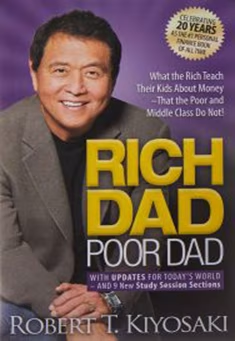
Rich dad poor dad pdf free download | Codeintra
Rich dad poor dad pdf free download. I had two fathers, a rich one and a poor one. One was highly educated and intelligent.
eBooks Category
| Personal Finance |
5
|
| Crypto Magazine |
26
|
| Self Help |
52
|
| Audio Books |
28
|
| Kids Stories |
2
|
| Education |
83
|
| Non-Fiction |
57
|
| Novels |
40
|
| Fiction |
10
|
Rich dad poor dad pdf free download
eBook Info
| Format |
Pdf
|
| Pages |
215
|
| Downloads |
0
|
| Views |
366
|
| Uploaded at |
18-Oct-2023
|
Download Link is Available

Rich dad poor dad pdf free download. I had two fathers, a rich one and a poor one. One was highly educated and intelligent. He had a Ph.D. and completed four years of undergraduate work in less than two years. He then went on to Stanford University, the University of Chicago, and Northwestern University to do his advanced studies, all on full financial scholarships. The other father never finished the eighth grade.
The overarching theme of Rich Dad Poor Dad is how to use money as a tool for wealth development.
It destroys the myth that the rich are born rich, explains why your personal residence may not really be an asset, describes the real difference between an asset and a liability, and much more.
Key takeaways/lessons learned
- Six lessons Robert Kiyosaki learned from his Rich Dad about making money and the mistakes that Poor Dad made
- Five obstacles to overcome before you can become rich and stay rich
- Ten steps to follow to develop your financial genius
- Actionable to-do steps you can put to work right away
Chapter/Section Summaries
Rich Dad Poor Dad contains a total of 10 chapters plus the introduction, but much of the book is focused on the first 6 parts or lessons.
We’ll cover the introduction and the first 6 lessons, then the remaining 4 sections later in this review.
- Introduction: Rich Dad Poor Dad
- Chapter 1: The Rich Don’t Work for Money
- Chapter 2: Why Teach Financial Literacy?
- Chapter 3: Mind Your Own Business
- Chapter 4: The History of Taxes and the Power of Corporations
- Chapter 5: The Rich Invent Money
- Chapter 6: Work to Learn – Don’t Work for Money
Introduction
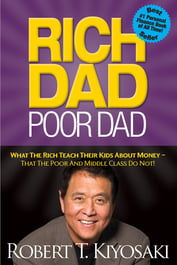 Robert Kiyosaki, author of Rich Dad Poor Dad, had 2 main influential fathers in his life.
 Poor Dad was Kiyosaki’s biological father, a man who was highly intelligent and very well educated. Poor Dad believed in studying hard and getting good grades, then finding a well-paying job. Yet, despite these seemingly positive attributes, Poor Dad didn’t do well financially.
Rich Dad was the father of Kiyosaki’s best friend. He had a similar work ethic to Kiyosaki’s real dad, but with a twist. Rich Dad believed in financial education, learning how money works, and understanding how to make money work for you. Although he was an eighth-grade dropout, Rich Dad eventually became a millionaire by putting the power of money to work for him.
The book is written from Kiyosaki’s perspective of how Rich Dad went about making money and the mistakes that Poor Dad made. The first 6 chapters of Rich Dad Poor Dad make up about two-thirds of the book and discuss the 6 lessons that Kiyosaki learned from his Rich Dad.
Chapter 1: The rich don’t work for money
Oftentimes people misunderstand the title of this chapter, and mistakenly believe that it means the rich don’t work. In fact, the complete opposite is true.
Instead of reading the chapter title as “The Rich Don’t Work for Money”, what Kiyosaki means to say is that “The Rich Don’t Work for Money.” Note that by putting the emphasis on the word “money,” this section takes on an entirely different meaning.
The truth is that the majority of rich people do work very hard, but they go about it differently than most people do. Rich people—and people who want to become rich—work and learn every day how to put money to work for them. As Rich Dad says, “The poor and middle class work for money. The rich have money work for them.”
Kiyosaki also notes that having a regular job is just a short-term solution to the long-term problem (or challenge) of creating wealth and financial freedom:
“It’s fear that keeps most people working at a job: the fear of not paying their bills, the fear of being fired, the fear of not having enough money, and the fear of starting over. That’s the price of studying to learn a profession or trade, and then working for money. Most people become a slave to money—and then get angry at their boss.”

Chapter 2: Why teach financial literacy?
The second chapter of Rich Dad Poor Dad explains the difference between an asset and a liability. Chapter 2 drives home the point that it’s not about how much money you make, but about how much money you keep.
An asset is something that has value, that produces income or appreciates, and has a market where the asset can easily be bought and sold:
- Assets produce income
- Assets appreciate
- Assets do both
Conversely, liabilities take money out of your pocket because of the costs associated with them. When Rich Dad Poor Dad was first published back in 1997, Kiyosaki created a lot of controversy with this statement.
That’s because by definition, a personal residence isn’t an asset unless it appreciates enough to offset the costs of ownership. On the other hand, rental property is an asset because it can generate enough passive income to exceed the expenses of operating and financing the real estate.
As Kiyosaki writes in Chapter 2 of Rich Dad Poor Dad, “Want to grow rich? Concentrate your efforts on buying income-producing assets – when you truly understand what an asset is. Keep liabilities and expenses low. You’ll deepen your asset column.”
Chapter 3: Mind your own business
There are 2 key messages in this chapter.
- First, pay off your debts and start investing in income-producing assets as soon as possible.
- Next, stay financially healthy by spending your time (instead of your paycheck) and investing as much of your money as possible in assets.
Kiyosaki notes in Chapter 3 of Rich Dad Poor Dad that most people confuse their profession with their business. In other words, they spend their entire lives working in somebody else’s business and making other people rich.
One of my favorite quotes from this section is:
“The primary reason the majority of the poor and middle class are fiscally conservative is that they have no financial foundation. They have to cling to their jobs and play it safe. They can’t afford to take risks.”

Chapter 4: The history of taxes and the power of corporations
When reading this chapter, it’s important to keep in mind that Kiyosaki wrote Rich Dad Poor Dad as a motivational book, not to provide expert financial or tax advice.
For example, Kiyosaki writes about the time he bought a Porsche and treated it as a business expense, using before-tax dollars. Buying a high-end luxury car when a much less expensive make and model would do could put an investor on the fast track to an IRS audit.
But putting the Porsche aside, the points made in this chapter discuss how to play the investment game smart. The rich understand the power of company structures and the tax code and use every legal means they can to minimize their tax burden.
Compare how business owners and investors with corporations such as C corps, S corps, or LLCs pay taxes to how most people pay tax:
Business owners with a corporate structure:
- Earn
- Spend
- Pay taxes
Employees who work for corporations:
- Earn
- Pay taxes
- Spend
Notice that employees who work for somebody else spend their money post-tax, while business owners earn and spend before paying tax.
Chapter 4 of the book also covers the 4 main components of what Kiyosaki calls “Financial IQ”: Accounting, Investment Strategy, Market Law, and Law.
As Rich Dad Poor Dad reminds us, understanding the legal and tax advantages significantly contribute to building long-term wealth:
“For instance, a corporation can pay expenses before paying taxes, whereas an employee gets taxed first and must try to pay expenses on what is left. . . Corporations also offer legal protection from lawsuits. When someone sues a wealthy individual, they are often met with layers of legal protection and often find that the wealthy person actually owns nothing [in their own name]. They control everything, but [personally] own nothing.”
Chapter 5: The rich invent money
Inventing money means finding opportunities or deals that other people don’t have the skill, knowledge, resources, or contacts for.
In Chapter 5, Rich Dad Poor Dad explains there are 2 types of investors:
- Investment packages are bought by people who entrust their money to a developer or fund manager. This is the way that most people invest, such as buying shares of an ETF or putting money into a real estate crowdfunding venture.
- Professional investors look after their own investments, research the market to find deals that make sense, then hire professionals to manage the daily oversight. Professional investors have 3 things in common:
- Identify opportunities that other people have not found
- Raise funds for investment
- Work with other intelligent people
Here’s one of my favorite closing thoughts from this chapter:
“Some people argue that there aren’t real estate bargains where they are, but there are prime opportunities everywhere that are overlooked. Most people aren’t trained financially to recognize the opportunities in front of them.”
Chapter 6: Work to learn—don’t work for money
Poor Dad was intelligent and well educated and worked for money because job security meant everything to him. Rich Dad became a millionaire by working to learn.
As Kiyosaki writes:
“I recommend to young people to seek work for what they will learn, more than what they will earn. Look down the road at what skills they want to acquire before choosing a specific profession and before getting trapped in the Rat Race.”
In fact, that’s exactly what Kiyosaki did. He joined the Marines after graduating from college and learned the essential business skills of leading and managing people. After serving his country, Kiyosaki joined Xerox, overcame his fear of rejection to become one of the top 5 salespeople in the company, then left the corporate world to form his own business.
Chapter 6 of Rich Dad Poor Dad then discusses the synergy of management skills needed for success in business:
- Cash flow management
- Systems management
- People management

Overcoming Obstacles
Chapter 7 of Rich Dad Poor Dad begins by noting that “the primary difference between a rich person and a poor person is how they manage fear.”
Robert Kiyosaki isn’t talking about the type of fear that some people have when going to the dentist or watching The Exorcist. In the book, “fear” is about the fear of losing money and how to handle that fear.
It’s one of the 5 biggest obstacles people face on the path to becoming financially independent:
- Fear
- Cynicism
- Laziness
- Bad habits
- Arrogance
These roadblocks—and the failure to overcome them—are why people who have studied and achieved financial literacy are still unable to develop assets that generate plentiful amounts of cash flow.
Fear
Losing money is a fact of investing life, and so is the fear that comes along with it. Kiyosaki notes that he’s never met a rich person who has never lost money, but he’s met plenty of poor people who have never lost a dime because they’ve never invested.
Real estate investors who choose to act only on a “sure thing” are paralyzed by fear in disguise. People who can’t see the big picture and think big are the ones who almost never, ever succeed in investing or in life.
Cynicism
Everybody has doubts that affect self-confidence, and it’s easy to fall into the trap of playing “What if?” especially when friends and family are constantly reminding you of your potential shortcomings.
Things like the economy crashing, interest rates rising, and tenants not paying their rent are common “what if” fears that all real estate investors have. While these are important items to consider, it’s important not to allow the cynicism of others to overtake your control. Otherwise, you may become immobilized as opportunities pass you by.
Laziness
In today’s interconnected world it’s easy to confuse being busy with actually accomplishing things that matter. In fact, according to Rich Dad Poor Dad, busy people are often the most lazy.
Busy people arrive at the office early and leave late. They bring work home to finish at night and on the weekends. Before they know it, the people and things that matter most to them have disappeared.
Instead of giving in to the call of the rat race and mistaking action for accomplishment, successful real estate investors are proactive and take care of themselves and their wealth first.
Bad habits
Habits control behavior. For example, most people pay their bills first before they pay themselves. The result is that there’s usually very little left over at the end of the month for investing.
Paying yourself first—even if you don’t have enough money to pay other people—makes you financially stronger, mentally and fiscally. In a way, it’s a form of reverse psychology.
When you develop the habit of paying yourself first, you become motivated by the fear of not being able to pay creditors. In turn, you begin looking for other forms of income like investment real estate.
Arrogance
Investors know what makes them money. But it’s the things they don’t know—and don’t know they don’t know—that makes them lose money. When people become truly arrogant, they honestly believe that what they don’t know doesn’t matter.
Train yourself to listen to what other people have to say, especially when it comes to money and investing. If you discover you’re ignorant about a subject, educate yourself or find an expert in the field.
Overcoming these 5 biggest obstacles on the path to real estate success requires a blend of balance and focus. There are plenty of “Chicken Littles” in the world today—people with a victimhood mentality who live their lives in cynicism and pessimism.
Rich Dad Poor Dad suggests filtering negative people and their fears out of your life. Instead, concentrate on the big picture and always ask, “What’s in it for me?”