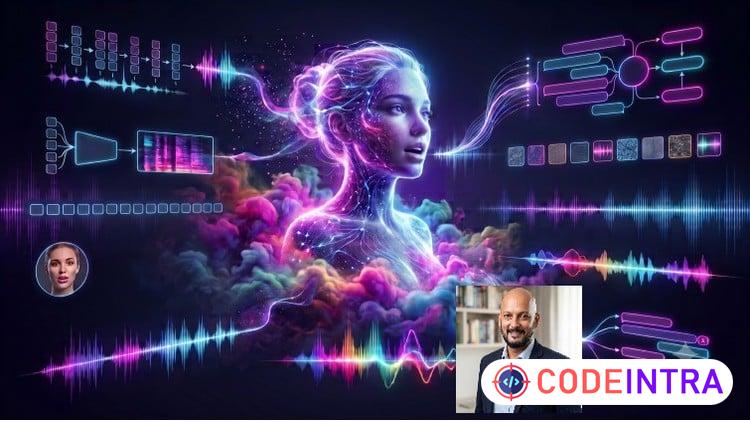
Mastering Generative Voice AI: From Tokens to Agentic TTS
Master SpeechLMs, neural audio codecs, diffusion & flow matching to build real-time agentic voice AI systems

Make Someone's Day
Share this incredible course!
Generative voice AI has moved far beyond simple text-to-speech — and this course takes you from the physics of sound all the way to building production-grade, agentic voice systems.
Most TTS courses stop at basic vocoders or off-the-shelf APIs. This one goes deeper. You'll start with the fundamentals of human speech — acoustics, phonetics, and prosody — before diving into the architectures actually powering today's state-of-the-art voice models: self-supervised representation learning (wav2vec 2.0, HuBERT), neural audio codecs (EnCodec, SoundStream, DAC), and the tokenization strategies that let LLMs "speak."
From there, you'll master the two dominant modern paradigms — autoregressive codec-based TTS and latent diffusion / conditional flow matching — understanding exactly when and why each is used in real systems. You'll also explore unified speech-text models, paralinguistic modeling (laughter, breathing, affect), and zero-shot voice cloning.
By the final module, you'll understand how to build low-latency, streaming, agentic voice pipelines — the same techniques behind real-time conversational AI agents — covering chunked inference, speculative decoding, WebSocket streaming, and turn-taking.
What you'll learn:
The science of speech production and acoustic feature extraction
How neural audio codecs and semantic tokenization work
Autoregressive and diffusion/flow-based TTS architectures
Cross-modal speech-text alignment techniques
Building low-latency, interruption-aware conversational voice agents
Whether you're an ML engineer, researcher, or voice-tech founder, this course gives you the complete architectural picture — from tokens to agents.
Learning Objectives
🔹Explain the physics, phonetics, and acoustic features that underlie human speech production🔹Compare traditional cascade TTS pipelines with modern Speech Language Model (SpeechLM) architectures
🔹Build and apply neural audio codecs and semantic tokenization (EnCodec, HuBERT, wav2vec 2.0, RVQ) (
🔹Implement autoregressive codec-based TTS with multi-stream token decoding strategies
🔹Design unified speech-text models with cross-modal alignment and paralinguistic control
🔹Apply latent diffusion and conditional flow matching to generate high-quality mel-spectrograms
🔹Evaluate flow matching vs. diffusion trade-offs for speed, quality, and controllability
🔹Deploy low-latency, streaming agentic TTS systems with real-time interruption handling
Prerequisites
🔹A solid understanding of deep learning fundamentals (neural networks, backpropagation, and training basics)🔹Working knowledge of Python and a deep learning framework such as PyTorch
🔹Basic familiarity with core NLP or LLM concepts (tokenization, transformers, attention) is helpful but not mandatory — key ideas are reviewed in the course
🔹No prior audio signal processing experience needed — Module 1 builds this from first principles
Who This Course Is For
🔹ML/AI engineers who want to move beyond calling TTS APIs and understand how state-of-the-art voice models actually work under the hood🔹Speech and NLP researchers looking to bridge classical signal processing with modern generative modeling (diffusion, flow matching, SpeechLMs)
🔹Voice-tech founders and product engineers building conversational AI agents who need to make informed architecture decisions
🔹Graduate students or self-taught ML practitioners seeking a rigorous, end-to-end curriculum on generative audio, from acoustic theory to agentic deployment
Course Details

| Price | FREE |
| Views | 0 |
| Lectures | 374 |
| Duration | 33 hours |
| Last Update | 17-Jul-2026 |
| Release Date | 17-Jul-2026 |
| Category | IT & Software |
|
30
|
|

This course includes:
📹 Video lectures
📄 Downloadable resources
📱 Mobile & desktop access
🎓 Certificate of completion
♾️ Lifetime access