Java DSA: LEETCODE Exercises — Linked Lists, Stacks & Queues
Java DSA — Linked Lists, Stacks & Queues (Solution Code with Detailed Explanations) | Coding Practice Exercises

Make Someone's Day
Share this incredible course!
This course contains the use of artificial intelligence.
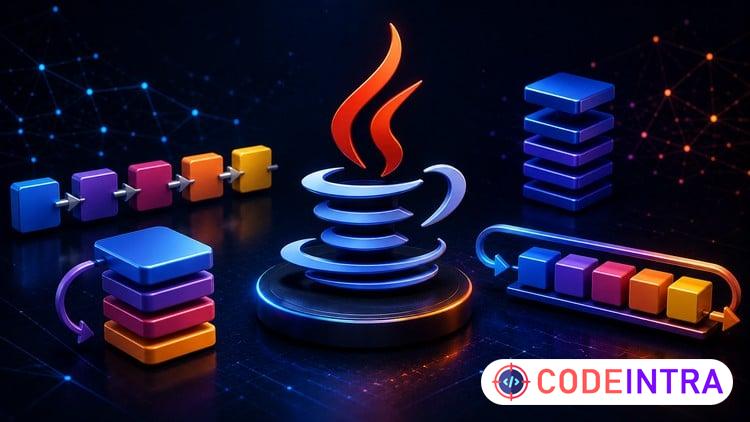
Java DSA: LEETCODE Exercises — Linked Lists, Stacks & Queues
Master core data structures and problem-solving patterns with hands-on Java practice.
Prepare to crack high-paying technical interviews and level up your engineering skills with this targeted, problem-driven practice course. Built specifically for software engineers, computer science students, and tech professionals, this course focuses on the most high-yield linear data structures and foundational algorithmic principles asked by top-tier tech companies.
Whether you are preparing for FAANG/MAANG coding rounds, competitive programming contests, or mid-to-senior developer assessments, this course bridges the gap between basic syntax and production-grade data structure manipulation. Every exercise includes a clear breakdown of the logic, robust Java implementations utilizing clean Object-Oriented Programming (OOP) principles, and deep dives into time and space efficiency.
Unlike theoretical lectures, this course emphasizes learning by doing. You won't just memorize solutions—you will learn how to spot core pointer patterns, manipulate node memory efficiently, leverage implicit/explicit stacks, choose the right collections, and optimize trade-offs.
What You'll Learn
Master LeetCode-style problems across linear data structures using clean, idiomatic Java.
Identify key algorithmic patterns in pointer manipulation, fast/slow pointer mechanics, and monotonic stacks/queues.
Write optimized, enterprise-ready code with rigorous Big-O time and space complexity analysis.
Leverage the Java Collections Framework (JCF) effectively (e.g., LinkedList, ArrayDeque, Stack) while also building structures entirely from scratch.
Think like an interviewer: Learn how to handle edge cases (null references, head/tail mutations, single-node lists, cycles) and explain your memory allocation clearly.
Topics Covered
Linked Lists
Foundations: Singly, Doubly, and Circular Linked Lists; Dummy Nodes; Memory Allocation.
Classic Patterns: In-place Reversal, Fast & Slow Pointers (Floyd’s Cycle Detection), Intersection of Two Lists.
Advanced Manipulations: Merging $K$ Sorted Lists, Palindrome Lists, Reordering, and Partitioning.
Stacks
Foundations: LIFO Mechanics, Array-based vs. Node-based Stack Implementations, Java's ArrayDeque vs. Stack.
Core Applications: Balanced Parentheses, Expression Evaluation (Infix/Postfix/Prefix), Function Call Stack simulation.
Algorithmic Patterns: Monotonic Stack (Next Greater Element, Daily Temperatures, Largest Rectangle in Histogram), Min/Max Stack Design.
Queues & Deques
Foundations: FIFO Mechanics, Double-Ended Queues (Deques), Circular Queues.
Core Applications: Breadth-First Search (BFS) building blocks, Task Scheduling, Buffering.
Advanced Patterns: Monotonic Queue (Sliding Window Maximum), Priority Queues & Heap integration, Designing Bounded Queues.
Course Features
Targeted LeetCode-Style Exercises: Curated, high-frequency questions drawn directly from modern tech interviews.
Complete Java Implementations: OOP-friendly, cleanly structured code leveraging standard Java practices.
Memory & Pointer Deep Dives: Clear explanations of reference passing, garbage collection behavior, and node allocation.
Step-by-Step Walkthroughs: From naive brute-force approaches to fully optimized, production-grade solutions.
Self-Paced & Practical: Designed for flexible, high-impact learning.
Why Take This Course?
Interviewing at top product-based companies requires flawless precision when managing references and memory flow. Linked Lists, Stacks, and Queues are the ultimate testing ground for your fundamental coding rigor—they form the backbone of memory management, operating system scheduling, parsing engines, and advanced graph algorithms.
This course gives you the exact blueprint to master these core data structures in Java, build rock-solid problem-solving muscle memory, and approach technical coding rounds with complete confidence.
Start coding, master core Java DSA, and land your dream tech role today!
Learning Objectives
🔹Master LeetCode-Style Exercises: Solve high-frequency interview questions covering Linked Lists, Stacks, and Queues using clean, idiomatic Java.🔹Apply Two-Pointer & Slow/Fast Mechanics: Implement core pointer techniques to detect cycles, find middle nodes, and calculate list intersections in $O(N)$ time.
🔹Perform In-Place Node Manipulations: Reverse, partition, and reorder singly and doubly linked lists without using extra memory space.
🔹Build Data Structures from Scratch: Construct custom Linked Lists, Stacks, Queues, and Deques without relying on built-in language abstractions.
🔹Master Monotonic Stack & Queue Patterns: Solve complex dynamic problems like Next Greater Element, Daily Temperatures, and Sliding Window Maximum.
🔹Leverage the Java Collections Framework (JCF): Choose the correct Java data structure (LinkedList, ArrayDeque, PriorityQueue) for maximum memory and execution e
🔹Handle Tricky Edge Cases: Write bug-free, production-grade code that gracefully handles null references, empty inputs, single-node cases, and memory leaks.
🔹Analyze Big-O Efficiency: Perform rigorous time ($O(N)$) and space ($O(1)$) complexity analyses for every algorithm and data structure operation.
🔹Simulate Real-World System Components: Utilize Stacks and Queues to model expression evaluators, call-stack executions, task schedulers, and BFS traversals.
🔹Optimize Brute-Force Solutions: Systematically refactor high-complexity naive solutions into optimal linear-time implementations.
🔹Explain Memory & Reference Allocation: Clearly articulate how Java handles reference passing, heap memory allocations, and garbage collection during interview d
🔹Communicate Technical Trade-Offs: Articulate design decisions, alternative data structure choices, and performance trade-offs like a senior engineer during live
Prerequisites
🔹Basic Java Knowledge: Familiarity with core syntax (variables, loops, conditional statements, and basic methods) and fundamental Object-Oriented Programming (OOP) concepts like classes and objects.🔹A Computer & IDE: A computer running Windows, macOS, or Linux with standard Java Development Kit (JDK) installed, alongside any Java-compatible IDE (such as IntelliJ IDEA, Eclipse, or VS Code).
Who This Course Is For
🔹Computer Science Students & Graduates seeking to bridge the gap between academic theory and practical, interview-grade Java DSA.🔹Software Engineers Preparing for FAANG/MAANG Interviews who need targeted, problem-driven practice on linear data structures and pointer mechanics.
🔹Java Developers looking to strengthen their low-level coding rigor, reference manipulation skills, and memory optimization techniques.
🔹Self-Taught Programmers & Bootcamp Graduates wanting to master high-yield LeetCode patterns to pass technical screening rounds.
🔹Backend Developers aiming to write efficient, enterprise-ready code by mastering time and space complexity trade-offs in Java.
🔹Competitive Programmers looking to sharpen their speed and accuracy on core data structure problems involving Stacks, Queues, and Linked Lists.
🔹Mid-Level Engineers aiming for senior roles who need to communicate algorithmic choices, edge-case handling, and Big-O efficiency clearly in live interviews.
🔹Developers Switching to Java who already understand basic programming but want to learn idiomatic Java practices and the Java Collections Framework (JCF).
🔹Tech Professionals Returning to Coding Interviews who need a structured, highly focused refresher on core technical assessment topics without unnecessary fluff.
Course Details

| Price | FREE |
| Views | 0 |
| Lectures | 10 |
| Duration | 37 mins |
| Last Update | 13-Aug-2026 |
| Release Date | 13-Aug-2026 |
| Category | Development |
|
30
|
|

This course includes:
📹 Video lectures
📄 Downloadable resources
📱 Mobile & desktop access
🎓 Certificate of completion
♾️ Lifetime access